Writing
OMSORG
At Jordens ressourcer er endelige, og at den måde, vi mennesker bebor planeten på, ikke er bæredygtig og ligger uden for det sikre handlingsrum (Safe Operating Space), er ingen nyhed. Som art og som del af et miljø har vi forskellige kulturelle relationer til det, der omgiver os. Nikolaj Schultz beskriver dette som en forhandlingsproces mellem ”mig og de skabninger, som muliggør mit liv, og de skabninger, som berøres af min eksistens og er indviklet i den.” ¹
Christine Bjerke anvender begrebet ”indvikling” – i modsætning til udvikling – til at beskrive en tilgang, der handler om at fordybe sig, at ”vikle sig ind i kompleksiteterne”, udfordre vores vaner og tage ansvar for, at alt påvirkes af arkitekturen.² I en verden præget af dybe globale og lokale kriser, som alle er forbundne som tråde, må der flettes nye forbindelser. At praktisere arkitektur med omtanke og omsorg kan skabe grobund for at forbinde arkitekter på tværs af landegrænser. Ved at vikle os ind i hinandens kompleksiteter og realiteter deles og skabes viden og inspiration for alle ”medskabere”.
I forlængelse af det aftryk, vi mennesker sætter blot gennem vores eksistens, har arkitekturen – som formende og indgribende proces – vidtrækkende konsekvenser for mennesker, dyr, planter og alt derimellem. Alt står i relation til hinanden. Arkitektens ansvar for at bruge de ressourcer, vi har, med omtanke og klogskab ligger i naturlig forlængelse af denne bevidsthed.
Noter:
1. Nikolaj Schultz, Landkrank. Ein Essay (Berlin: Suhrkamp, 2022), 224.
2. Christine Bjerke, “Klumme: Indvikling,” Arkitektforeningen,
https://arkitektforeningen.dk/nyheder/klumme-indvikling
© Elin Hirsch — Do not copy without permission.
ALLES IST UMBAU
EVERYTHING IS RE-CONSTRUCTION
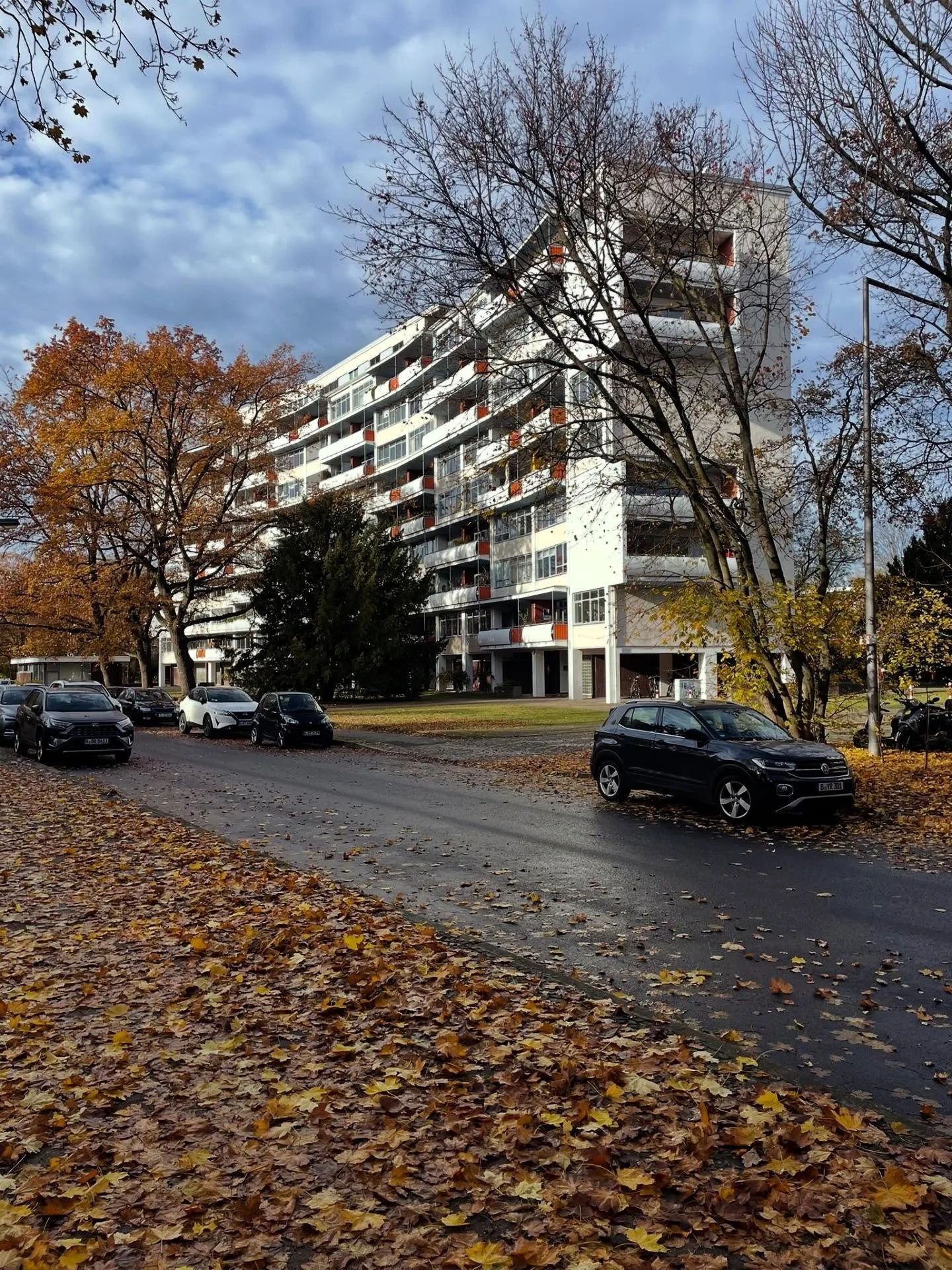
While staying in Berlin, I had the chance to spend a few nights at a friend’s place. It is a three-bedroom apartment in the Gropiushaus in the Hansaviertel, where she and her family have lived for many years. Completed in 1957 for the International Building Exhibition (Interbau), it was designed by Walter Gropius in collaboration with his US-based firm The Architects’ Collaborative (TAC) and Berlin architect Wils Ebert. Since 1980, it has been listed as a historic monument.¹
Staying there for a few nights makes it possible to inhabit the apartment in a more attentive way — to experience it not only as a guest, but as an architect with an interest in the effects of space on mind and body. Through the use of our senses (especially sight and conscious reflection), one slowly begins to understand which parts are original — in place since the building’s construction — and which have been added over time. Small adaptations and alterations made by successive occupants, changes in material or form — small-scale rebuilding, since it is a listed building where major modifications are not permitted.
And does it really matter? Within the longstanding discourse of architectural conservation and preservation, the question of what should remain unchanged has been debated for decades. Approached differently depending on cultural traditions, and governed differently from country to country, the discussion has increasingly focused on whether (cultural) heritage must be understood as purely physical — and, if so, how much of it must remain untouched. Is the original, or the older, inherently better? Or does preservation risk constraining how we live and dwell as human beings — limiting our ability to make spaces our own, to create homes?
Here, Hermann Czech’s phrase “Alles ist Umbau” (from Zur Abwechslung, 1973) comes to mind. He paraphrased Hans Hollein’s “Everything is architecture” into “Everything is rebuilding” (1989), highlighting the existing built environment and reminding us that everything is constantly under reconstruction and being rebuilt.
According to Czech, no building, city, or design process is ever static or self-contained, but rather a dynamic, open, and never-finished process (Der Umbau, 1989).For him, the design process is a series of decisions in which later decisions are constrained by earlier ones, whether they are one’s own or those of others:
«(…) jede einzeln gefasste Entscheidung bindet die späteren Entscheidungen, weil es einen Aufwand bedeutet, sie wieder rückgängig zu machen.»²
He describes a circular process in which everything architects do adds a new layer — not only material, but also social and cultural — to the existing ones (“historische Mehrdeutigkeit”).
Reflecting on Czech’s ideas in light of the ecological, political, and social crises we face today — and a design practice increasingly marked by uncertainty — his thinking seems more relevant than ever. Not only as a way of approaching refurbishment and rebuilding, but also as a way of asking how we can sustainably reconstruct existing structures: material, social, and cultural ones.
1. Landesdenkmalamt Berlin. 2025. “Bauten der Interbau 57, Hansaviertel (Obj.-Dok.-Nr. 09050387,T).” Denkmaldatenbank. Accessed November 16, 2025. https://denkmaldatenbank.berlin.de/daobj.php?obj_dok_nr=09050387.
2. Hermann Czech, “Alles ist Umbau,” in Umbauen = Transformer = Transforming, Werk, Bauen + Wohnen 85 (Zürich: Bund Schweizer Architekten, 1998), 4–10.
© Elin Hirsch — Do not copy without permission.
SUSTAINABLE TRANSFORMATIONS IN MATERIAL + CULTURAL LANDSCAPES
SUSTAINABLE TRANSFORMATIONS IN MATERIAL + CULTURAL LANDSCAPES
studio@elinhirsch.com
T +45 4231 0239
Svendborg (DK)
© ® ELIN HIRSCH 2026
& collaborator(s)
Site by Studio Thomas Cassander
Images used as showcase only.